Research Output
First-Author Publications
-
Abundant hydrocarbons in a buried galactic nucleus with signs of carbonaceous grain and polycyclic aromatic hydrocarbon processing
García-Bernete I., Pereira-Santaella M., González-Alfonso E., et al., 2026, Nature Astronomy, 10, 420G -
GA-NIFS: AGN activity in a Lyα emitter within a triple-AGN system anchored by a passive galaxy at z = 3
Perna M., Arribas S., Hamed M., et al., 2026, A&A, 710, A167 -
GA-NIFS: The highest-redshift ring galaxy possibly resulting from a head-on collision
Perna M., Arribas S., Costantin L., et al., 2026, A&A, 713, A86 -
GA-NIFS: The interplay between feedback and star formation at z=3-9 probed by JWST/NIRSpec IFU
Ulivi L., Perna M., Arribas S., et al., 2026, A&A, in press
Awarded Observing time
-
Yebes-RT40 - 2025B
Tracing the organic complexity in buried nuclei: An extragalactic molecular inventory.
PI: García-Bernete I. (ID: 25B044; ~60 hours) -
ALMA + JWST Cycle 12
Probing cold gas, dust, and stars to solve the quenching puzzle in Jekyll and Hyde.
PI: Perna M. (ID: 2025.1.01246.S; ~30 hours) -
NOEMA - Summer 2026
The cold molecular gas content of dual AGN.
PIs: Lamperti I., Perna M. (ID: S26CC; ~45 hours)
Brief description of each publication
-
GA-NIFS: AGN activity in a Lyα emitter within a triple-AGN system anchored by a passive galaxy at z = 3
Perna M., Arribas S., Hamed M., et al., 2026, A&A, 710, A167
Previous JWST GA-NIFS observations had uncovered a remarkable environment around GS10578, one of the earliest known massive quenched galaxies, revealing an AGN at its centre and a second actively accreting black hole in a satellite only a few kiloparsecs away (D’Eugenio et al. 2024, Perna et al. 2025, Scholtz et al. 2026). In this work, using new JWST/NIRSpec IFU and VLT/MUSE observations, we explored its wider environment and confirmed that a nearby Lyα-emitting satellite also hosts an actively growing supermassive black hole, establishing the presence of a rare triple-AGN system within a region only a few tens of kiloparsecs across. We also investigated a second Lyα source that remains undetected in deep imaging and spectroscopy, finding evidence that its emission is powered by radiation from the neighbouring AGN rather than by its own stars. These results reveal that massive quenched galaxies can reside in surprisingly dynamic and gas-rich environments, where black-hole growth, feedback, and satellite interactions continue to shape galaxy evolution long after star formation has ceased.
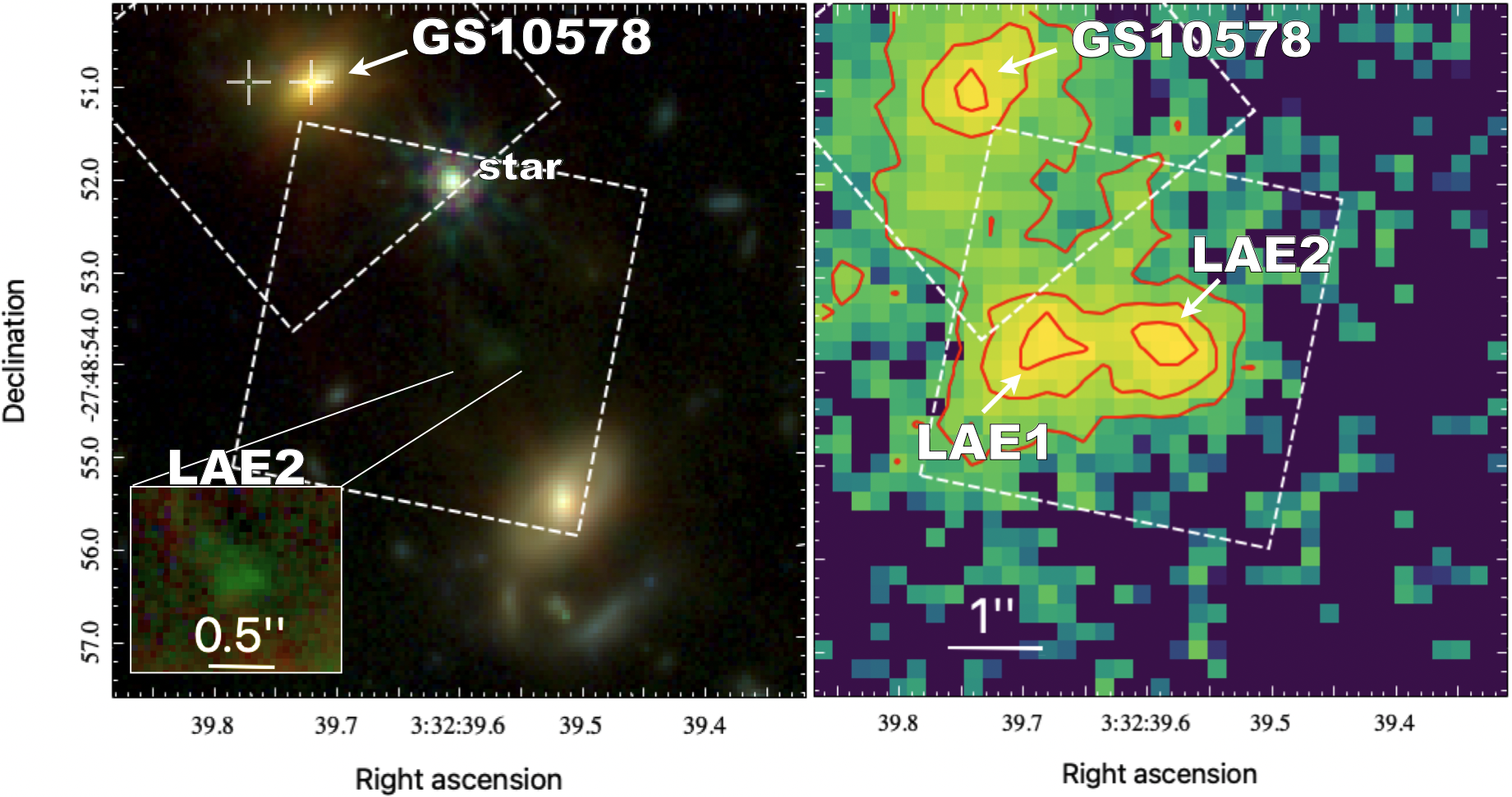
Environmental context of GS10578 and its close emitters. Left: NIRCam three-colour composite image; Right: VLT/MUSE narrow-band image obtained by integrating over the Lyα line
-
The highest-redshift ring galaxy possibly resulting from a head-on collision
Perna M., Arribas S., Costantin L., et al., 2026, A&A, 713, A86
Using JWST/NIRSpec integral-field spectroscopy, we discovered and studied GS18660, a remarkable ring galaxy at redshift z=3.076, when the Universe was only about 2 billion years old. The galaxy hosts a prominent ~3.5 kpc star-forming ring, a bright central region, and a close companion connected by faint emission and tidal structures. Its gas is rotating but also shows substantial non-circular motions, while the stellar populations indicate a recent burst of star formation concentrated in the ring. Together, the morphology, companion, stellar populations, and complex gas kinematics favour a scenario in which the ring was produced by a recent galaxy collision. However, the data cannot completely exclude an alternative interpretation in which the ring is associated with a recently forming bar and resonances. GS18660 therefore offers a unique laboratory for studying how galaxy interactions and internal dynamical structures develop in the early Universe.
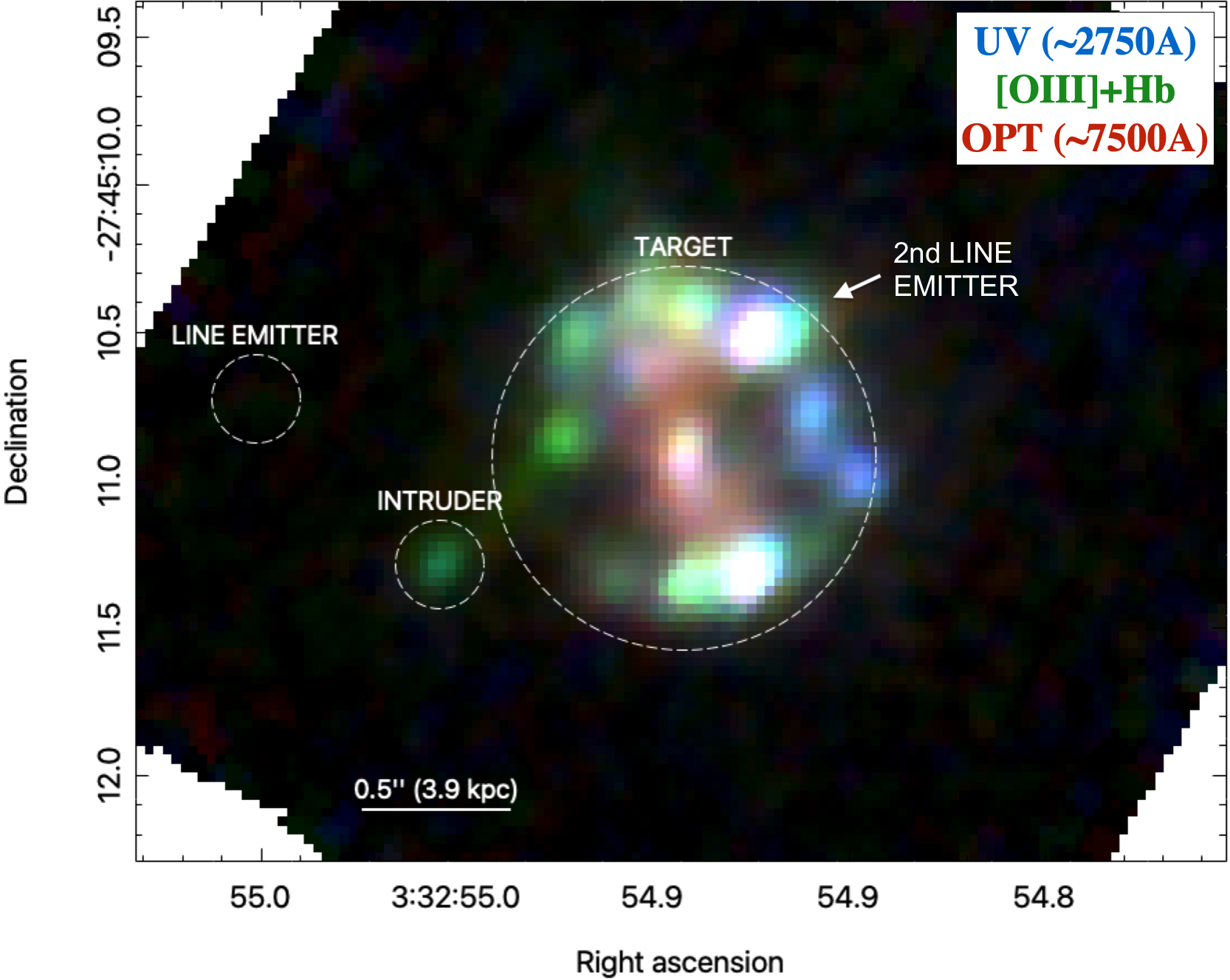
Three-colour composite image showing the environmental context of the ring galaxy GS18660 and its close companion and emitters.